
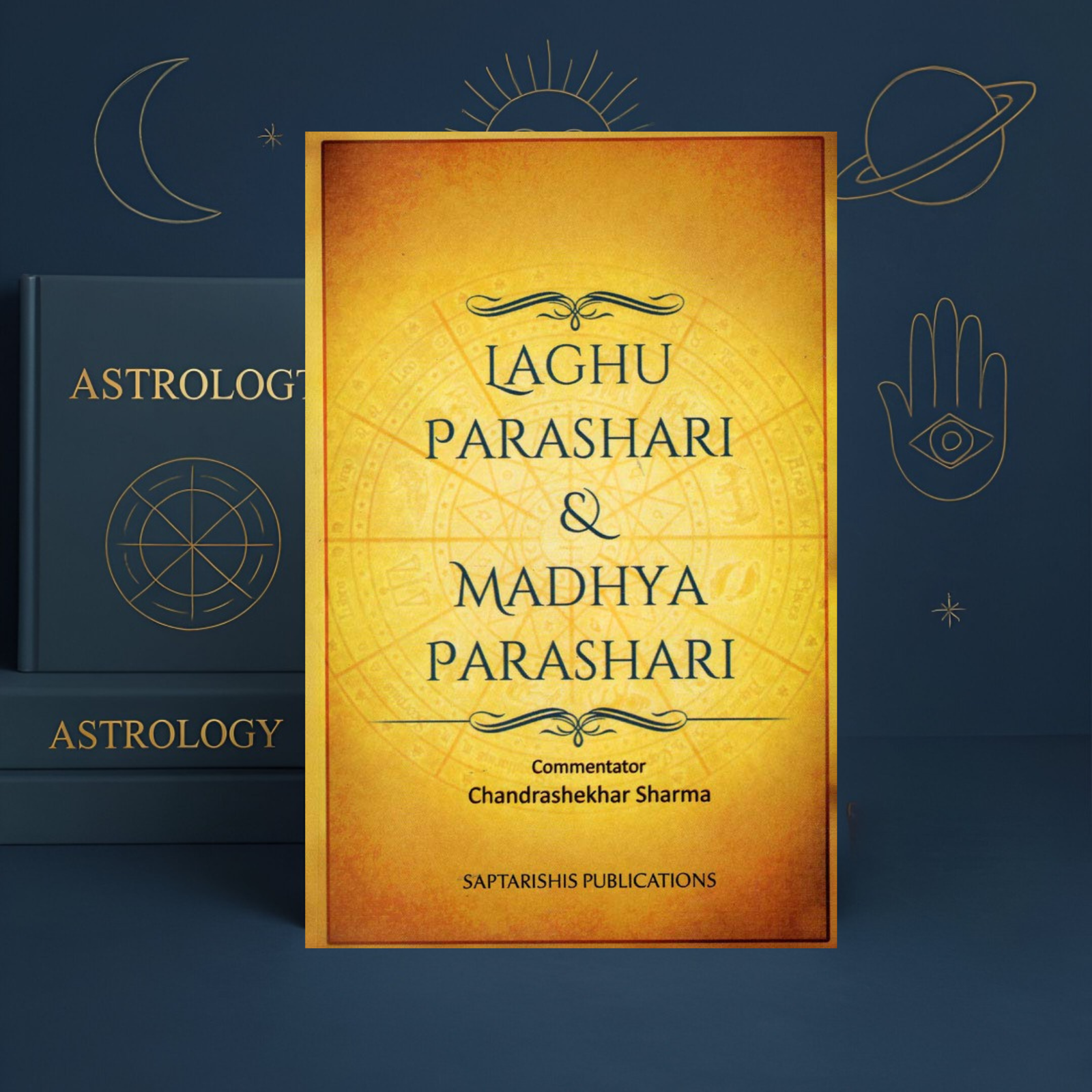
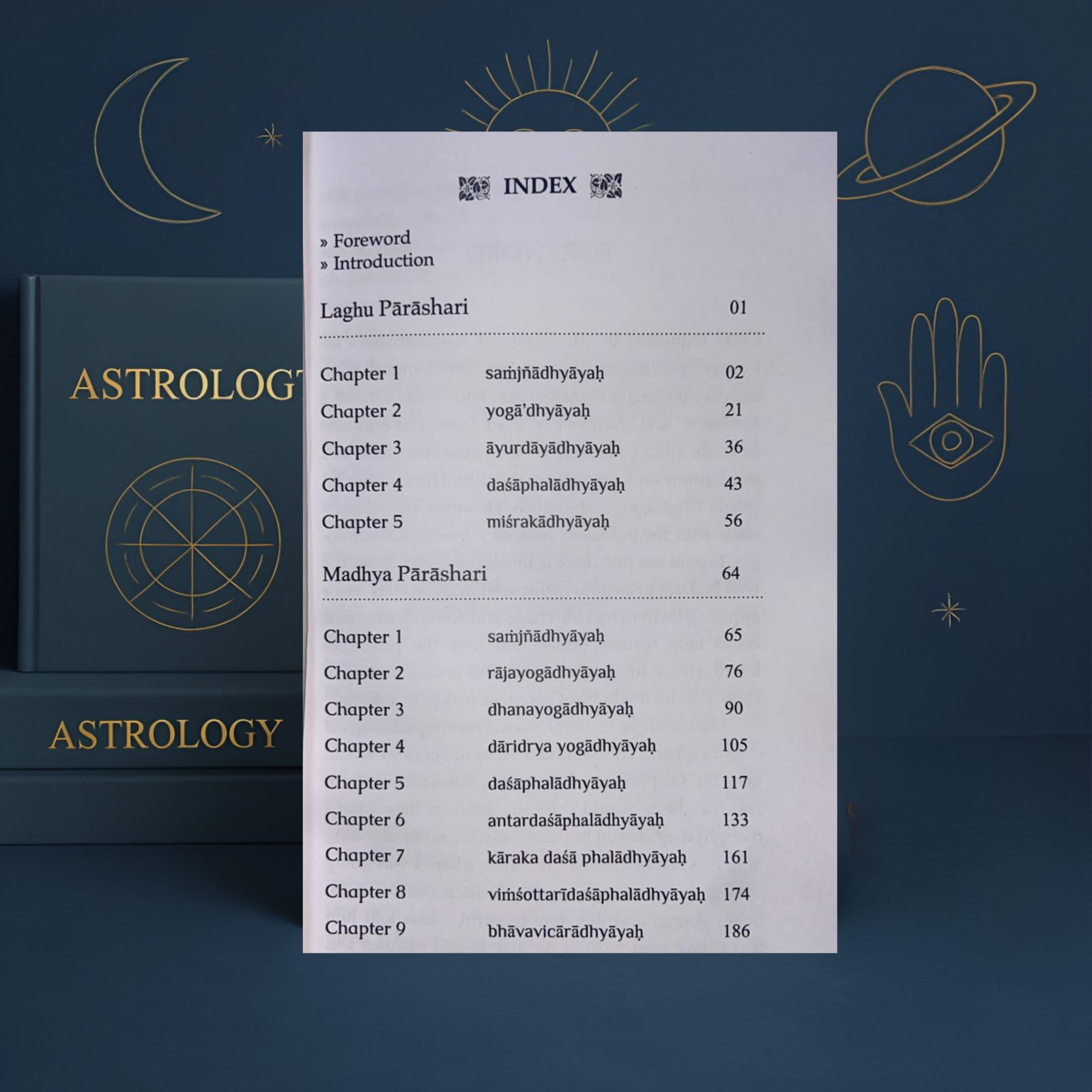
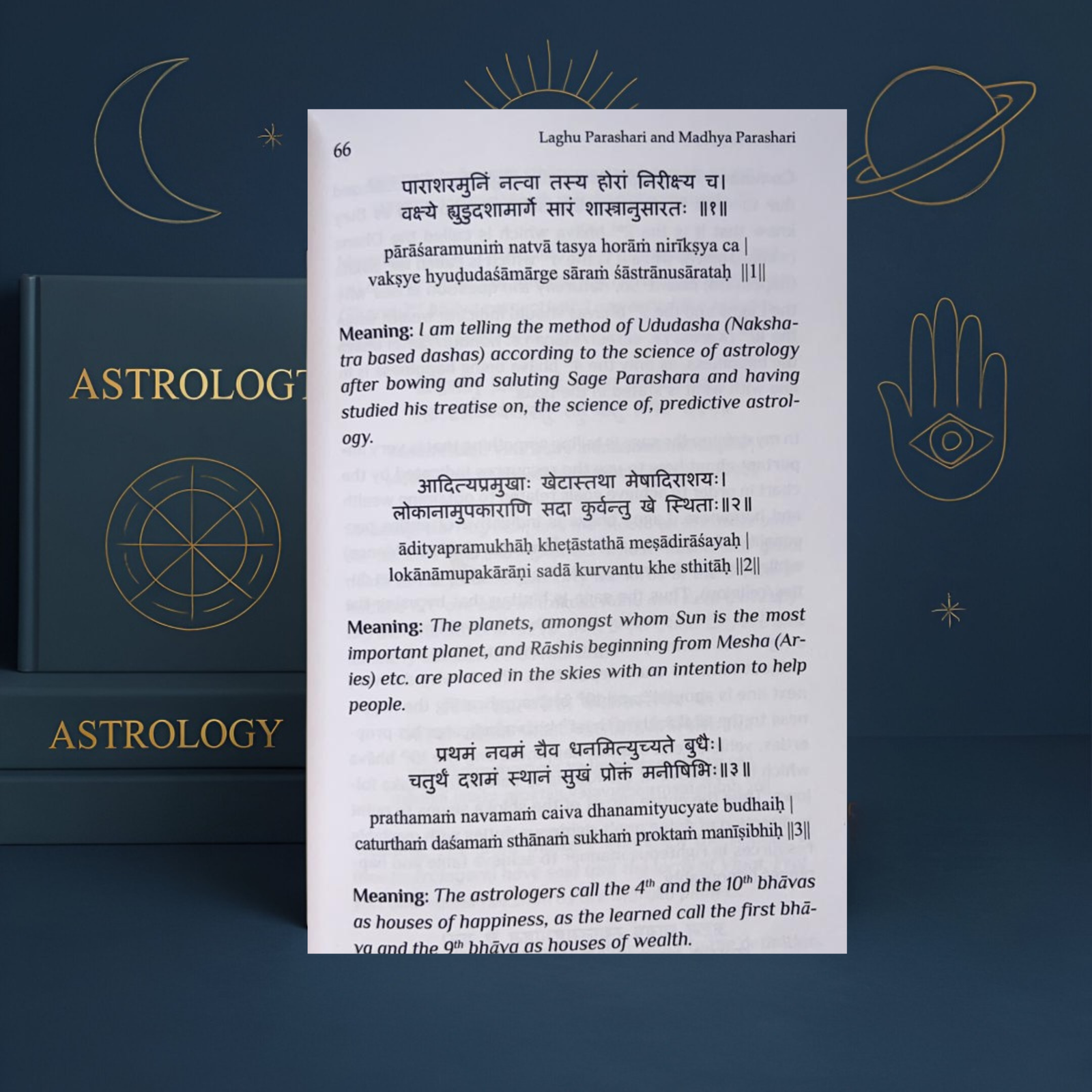
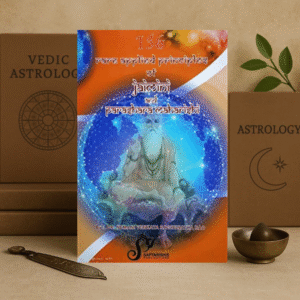
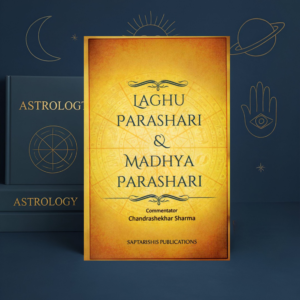
Laghu Parashari and Madhya Parashari by Chandrashekhar Sharma is a specialized English commentary on two important classical texts of Parashari Astrology. Published by Saptarishis Publications, this book provides a detailed explanation of the principles behind Laghu Parashari and Madhya Parashari and focuses particularly on the practical application of Vimshottari Dasha for horoscope interpretation and prediction.
Laghu Parashari is traditionally associated with the application of Vimshottari Dasha principles, while Madhya Parashari expands the study of Dasha-based predictive concepts. Chandrashekhar Sharma’s commentary is intended to explain the reasoning and astrological principles underlying the results described in these concise classical texts.
The book is particularly valuable for readers who want to understand not only what a Dasha rule states, but also how that rule can be applied while judging an actual horoscope.
Classical Parashari Astrology
The book provides a focused study of Parashari Astrology and its predictive framework. Readers are introduced to the principles underlying planetary relationships, house significations and Dasha results.
Because the original classical texts are comparatively concise, detailed commentary can be useful for students who want a clearer understanding of how the individual Sutras and rules are applied in practical horoscope analysis.
Laghu Parashari
Laghu Parashari is an important traditional text dealing with the application of Vimshottari Dasha. The book explains the principles behind its Dasha-related rules and places them within the broader framework of Parashari predictive astrology.
Readers can study the relationship between planets, houses, lordships and Dasha periods while developing a more structured approach to horoscope interpretation.
Madhya Parashari
Madhya Parashari is presented together with Laghu Parashari in this volume. It provides an additional layer of Parashari principles and helps readers explore the Dasha-based predictive framework in greater detail.
The combined presentation makes the book useful for students who want to study these related classical works in one reference.
Vimshottari Dasha
One of the central subjects of the book is Vimshottari Dasha. The methodology explains how planetary periods can traditionally be used to assess the unfolding of events in a horoscope.
A particularly important feature is the treatment of lower-level Dashas. Readers can explore not only the major Mahadasha but also the increasingly specific sub-periods and their role in refining predictive analysis.
Antardasha and Lower-Level Dasha Analysis
Predictive astrology often requires greater timing precision than a Mahadasha alone can provide. The book therefore gives attention to the use of lower-level Dasha periods within the Vimshottari system.
This allows students to explore how broad planetary periods can be further divided and examined in relation to specific life events.
The approach is particularly useful for readers who want to develop their understanding of event timing through Dasha Astrology.
Principles Behind Dasha Results
A major purpose of the commentary is to explain why particular Dasha results are traditionally expected.
Instead of presenting the rules only as isolated statements, the book examines the Vedic Astrology principles behind them. This can help readers understand how planetary lordship, placement, relationships and house significations contribute to the interpretation of a Dasha.
Predictive Astrology
The book has a strong Predictive Astrology orientation. Its central concern is how Dasha principles can be used to understand what may unfold during particular periods.
Readers can study how the natal horoscope provides the basic indications while the Dasha system is traditionally used to examine when those indications may become active.
Timing of Events
Timing is one of the most important practical applications of Vimshottari Dasha.
The book provides a structured approach to studying event timing by examining the running Dasha and its sub-periods in relation to the natal chart.
This makes the work especially relevant to astrologers and students who want to move from general horoscope interpretation toward more specific timing analysis.
Planetary Lordship and House Significations
A proper understanding of Dasha results requires attention to the houses ruled by the Dasha planet. The book examines these traditional relationships and explains how planetary lordship contributes to the interpretation of Dasha periods.
Readers can therefore study:
• Planetary ownership of houses
• Planetary placement
• House significations
• Planetary relationships
• Dasha lordship
• Sub-period influences
• Overall horoscope context
These factors can be considered together rather than interpreting a Dasha planet in isolation.
Practical Horoscope Interpretation
The commentary is designed to bridge the gap between classical theory and practical horoscope reading.
Readers can use the explanations to understand how a classical rule can be applied to an actual birth chart and how multiple indications may be combined while interpreting a Dasha period.
This practical emphasis makes the book suitable for serious students as well as practitioners of Vedic Astrology.
Classical Text with Detailed Commentary
The original Laghu Parashari and Madhya Parashari texts are concise works. Their brevity can make some principles difficult for modern students to interpret without additional explanation.
This edition provides a more detailed commentary intended to clarify the traditional principles and demonstrate their application.
The commentary helps readers understand the underlying logic of the rules and their place within the larger Parashari system.
Dasha-Based Horoscope Prediction
A central theme is the relationship between the natal horoscope and the Dasha system.
The natal chart traditionally shows the potential or promise, while Dasha periods are examined for the timing of manifestation. The book develops this concept through its discussion of Vimshottari Dasha and its lower divisions.
This makes it useful for readers interested in structured horoscope prediction and event timing.
Important Areas Covered
• Laghu Parashari
• Madhya Parashari
• Parashari Astrology
• Vimshottari Dasha
• Mahadasha
• Antardasha and lower-level Dashas
• Dasha interpretation
• Planetary lordship
• House significations
• Planetary placement
• Predictive horoscope analysis
• Timing of events
• Dasha-based prediction
• Classical Jyotish principles
• Practical Vedic Astrology
Understanding Dasha Progression
Dasha analysis becomes more detailed as the practitioner moves from major planetary periods into their subdivisions. The book gives readers a framework for understanding this progression and for interpreting lower-level Dashas in a systematic manner.
This can be particularly useful when students want to understand how a broad period can be narrowed down to more specific timing windows.
Why This Book Is Useful
The book combines two classical Parashari texts with a detailed English commentary, making the material easier to approach for modern readers.
Its focus on Vimshottari Dasha and predictive application makes it especially useful for readers who want to study Dasha Astrology in greater depth rather than limiting themselves to introductory definitions.
The book also provides a bridge between classical Jyotish literature and practical horoscope interpretation.
Practical Study Approach
Readers can approach the material by first understanding the basic principles of Laghu Parashari and Madhya Parashari and then examining how those principles operate within a complete birth chart.
A systematic study can involve:
• Identifying the relevant houses
• Examining the Dasha lord
• Studying planetary lordship
• Considering planetary placement
• Examining Dasha and Antardasha
• Comparing the indications with the horoscope as a whole
• Studying the timing of events
Suitable for Vedic Astrology Students
This book can be useful for:
• Vedic Astrology students
• Parashari Astrology learners
• Predictive Astrology students
• Dasha Astrology practitioners
• Jyotish researchers
• Astrology teachers
• Professional astrologers
• Advanced horoscope analysts
• Readers studying classical astrology texts
It is particularly appropriate for readers who already have a foundation in planets, signs and houses and want to develop a deeper understanding of Dasha-based predictive techniques.
About the Author
Chandrashekhar Sharma is an author, teacher and long-time student of Vedic Astrology. His writing emphasizes explaining classical Jyotish principles in a structured and practical manner, with particular attention to understanding the underlying reasoning behind predictive rules.
Book Details
Title: Laghu Parashari and Madhya Parashari
Author: Chandrashekhar Sharma
Publisher: Saptarishis Publications
Language: English
Laghu Parashari and Madhya Parashari is a specialized reference for readers interested in Parashari Astrology, Vimshottari Dasha, Dasha Prediction, Horoscope Timing and Classical Vedic Astrology. Its detailed commentary and focus on lower-level Dasha application make it particularly useful for students and practitioners who want to develop a deeper understanding of predictive Jyotish.



Reviews
There are no reviews yet.